Introduction
The main obstacle to multiple devices use is that RSL Helper is not a natively “Cloud-Based” application. It relies on local Memory Offsets and specific file paths that vary from one machine to another. If you simply copy-paste the folder without a safety plan, the software may attempt to use “PC A’s” hardware settings on “PC B,” resulting in instant application hangs or “Null Reference” errors.
Why settings may break across machines
Configurations frequently break because of Path Inconsistency. If RSL Helper is installed in C:\Games on your desktop but D:\RSL on your laptop, the internal pointers in the Settings.ini file will become “orphaned,” preventing the app from finding your custom gear filters.
Data soundness and compatibility concerns
When moving data between devices, Binary Compatibility is necessary. Running an older build of the Helper on one machine and a newer build on another, while sharing the same configuration files, can lead to “Schema Mismatches,” where the older software cannot read the new data tags, causing a complete settings reset.
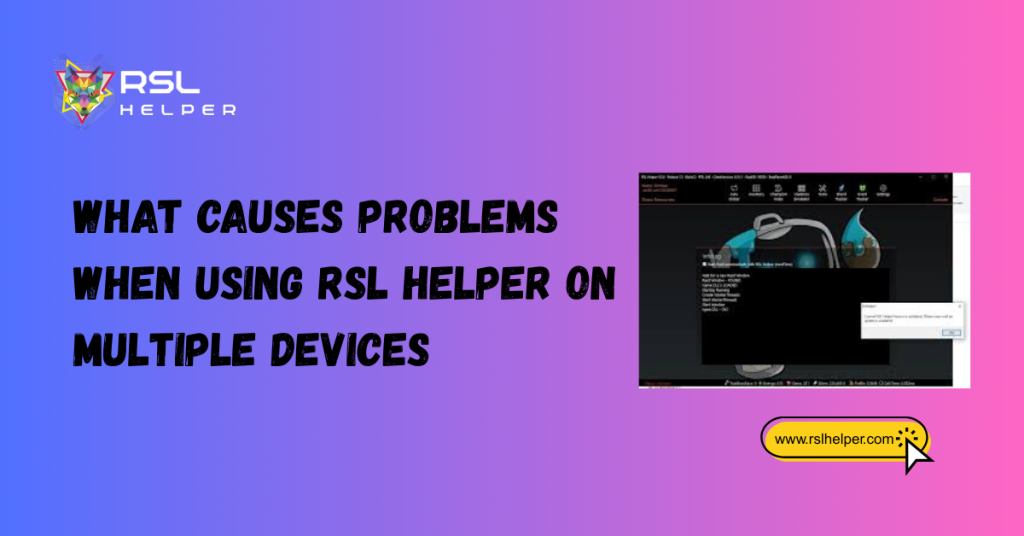
What Causes Problems When Using RSL Helper on Multiple Devices
Different OS Environments
Windows 10 and Windows 11 handle Kernel Permissions and “Background Process Priority” differently. If you move a configuration from a Windows 10 desktop to a Windows 11 laptop, you may encounter Thread Delay problems. This is because Windows 11 often aggressively suspends background apps to save power. To maintain Binary Stability, you must ensure that each device has its own “Graphics Settings” profile in Windows, forcing the app to run in “High Performance” mode regardless of the OS version.
Conflicting Config Versions
One of the most common causes of a “Settings Reset” is a version mismatch. If “PC A” is running a newer beta build and “PC B” is on a stable release, the XML Schema in the configuration files will be different. When the older version tries to read a new data tag (like a new gear set filter), it results in a Parsing Failure. This causes the software to revert to a “Factory Default” state, potentially wiping your custom automation rules. Always check that the Build Version is identical across all devices before syncing.
Inconsistent App Directories
RSL Helper relies on Hardcoded Pathing in its registry keys. If your main PC has the game on an SSD labeled E: drive, but your laptop uses the C: drive, the “Handshake” between the Helper and the Game Client will fail. These inconsistent directories lead to “Invalid Path” errors. To fix this, you must manually re-path the Game Directory in the settings menu every time you switch to a machine with a different storage layout to ensure the Memory Offsets are correctly targeted.
Managing Safe Multi-Device Transfers
Keeping settings synced correctly
Focus on the Autosell and Config folders. These are your Semantic Assets. Instead of syncing the entire 1GB+ installation folder, only transfer these lightweight folders. This ensures the core binaries remain native to each machine’s specific hardware drivers and registry settings.
Avoiding duplicate file structures
When moving files via USB or Cloud, avoid creating “Nested Folders” (e.g., RSLHelper\RSLHelper). This common mistake prevents the software from finding Updater.exe, leading to a “Update Service Unavailable” loop that prevents the app from verifying its build status.
Preventing overwrite errors
Always use a “Compare and Merge” method rather than a “Blind Overwrite.” If you have made changes to your gear filters on your laptop, ensure you don’t accidentally overwrite them with an older version from your desktop. Use timestamps to verify the most recent Data State before confirming the move.
Protecting Game Data and Profiles
Backing up core folders: Before any transfer, create a compressed .zip archive of your working setup. This acts as a Point-in-Time Recovery snapshot. If the synchronization fails on the second device, you can revert both machines to a known stable state without losing your “Mercy Counter” or “Shard Statistics.”
Verifying file integrity: After moving files to a new device, run the RSL Helper Updater. This tool performs a Checksum Verification to ensure that no .dll files were corrupted during the transfer. A single bit-flip during a USB transfer can cause the “Direct Memory Access” (DMA) to fail.
Restoring clean settings states:If you encounter errors after a transfer, delete the Cache folder on the new machine. This forces RSL Helper to generate a Native Image Index for that specific device’s GPU and monitor, eliminating the “Black Screen” rendering issues frequently seen in multi-device setups.
Avoiding Version Conflict Errors
- Matching builds across devices: Ensure that both machines are running the exact same Binary Version. Check the “About” section or the file properties. A version mismatch is the primary cause of “Settings Reset” issues during multi-device use.
- Tracking updates and changes: If you update the Helper on your desktop, you must update it on your laptop before syncing the config files. This prevents Downward Compatibility conflicts where newer data structures break older software versions.
- Isolating incompatible installs: If one machine is significantly older (e.g., a laptop with integrated graphics), avoid syncing the “Graphics” or “Rendering” settings. Keep those settings Hardware-Bound to ensure the app stays stable.
Setting Up Separate Device Configurations
Using unique folders per PC
The safest approach is to perform a Clean Installation on each PC and share only the Autosell rules. This allows each machine to maintain its own Registry Keys and “App Data” traces, which are specific to that computer’s Windows installation and user permissions.
Handling multi-profile usage
If you manage multiple accounts, use the “Profiles” feature within RSL Helper. Name your profiles clearly (e.g., “Main_PC1” and “Main_Laptop”). This prevents the software from trying to load “PC1” window coordinates on a “Laptop” screen, which often causes the app to render “Off-Screen.”
Preventing shared-file corruption
Never point two active instances of RSL Helper to the same Network Drive or “Live” Cloud folder. If both machines try to write to the Settings.ini at the same time, it creates a Race Condition that will permanently corrupt the file structure.
Guaranteeing Safe USB and Cloud Syncing
Secure external transfer steps:When using a USB drive, always “Eject” the drive safely via Windows. Pulling a drive while RSL Helper is closing can result in a Partial Write, leaving your configuration files at 0KB—effectively deleting all your hard-coded gear filters and settings.
Safe cloud storage practices: If using OneDrive or Dropbox, set the RSL Helper folders to “Always keep on this device.” Cloud “On-Demand” features can cause the Helper to hang for several seconds while it waits for a file to download, leading to a “Not Responding” crash.
Hidden sync mistakes to avoid: Avoid syncing the Logs folder. These files can become massive and are completely useless on a different machine. Syncing them only wastes bandwidth and increases the risk of File Indexing Delays that slow down the app’s startup on the second device.
Troubleshooting Multi-Device Issues
Fix mismatched configurations
If the UI looks “Stretched” or “Broken,” delete the Settings.ini and let the app rebuild it locally. Then, re-import only your Autosell filters. This fixes UI Scaling Conflicts while keeping your automation logic intact.
Resolve invalid path errors
If the app says it can’t find the game, go to the settings and manually re-path the Game Directory. Multi-device users often forget that their game might be on the C: drive on one PC and the D: drive on another, which can cause the “Handshake” to fail.
Repair broken data links
If your “Mercy Counter” is missing, ensure the Database.db file was moved. Without this file, the Helper starts from scratch, creating a Data Gap in your account-tracking. Verify the file path in the app settings to guarantee it points to the new local directory.
Frequently Asked Questions
Can I run RSL Helper on two PCs without breaking data?
Yes, but you must avoid Simultaneous Cloud Syncing. The safest method is to manually transfer the Autosell and Config folders while the app is closed on both machines to prevent data collisions.
Will different Windows versions cause conflicts?
Windows 10 and 11 have different Driver Architectures. While the Helper works on both, you should not sync the “System” or “Renderer” settings between them to avoid Kernel-Level Crashes and rendering errors.
What’s the safest way to sync settings between machines?
The safest way is to use a Manual USB Transfer of just the Config and Autosell folders. If you use the cloud, ensure the files are set to “Offline Access” and always close the app completely before switching devices.
Do I need identical RSL Helper builds on each device?
Yes. Version Parity is essential. If “PC A” has a newer version with new data fields, “PC B” (with an older version) will not comprehend those fields and may delete them or crash when trying to load the settings.
Why is my config corrupted after switching PCs?
Corruption is usually caused by DPI Scaling Mismatches or Partial Cloud Syncs. If the Helper tries to load a coordinate map that doesn’t fit the second PC’s resolution, the file structure can become invalid during auto-correction.
Can cloud sync overwrite my settings?
Yes, if not managed carefully. Cloud services use a “Latest Version Wins” logic. If you close the app on your laptop and it syncs a default config before your desktop can sync its “Custom” config, you may lose your settings.
How do I prevent file duplication problems?
Only sync the Internal Data Folders, never the root installation folder. By keeping the .exe and .dll files local to each machine, you prevent “Ghost Duplication” of binaries, which can confuse the Windows Registry.
What happens if two devices modify the same data?
This creates a Data Collision. The most likely outcome is that one set of changes will be lost, or the configuration file will become “Null,” forcing RSL Helper to reset to factory defaults on the next launch.
Conclusion
Mastering the use of RSL Helper on multiple devices is the ultimate way to maintain an edge in Raid: Shadow Legends. The secret to a conflict-free experience lies in Strategic Isolation: keep your heavy binaries and hardware-specific settings local to each computer, while only syncing the “Intelligence”—your gear filters and sell rules.
You eliminate the technical friction that leads to crashes and data loss. Treat each machine as a unique environment, verify your versions, and always maintain a “Master Backup.” This methodical approach ensures your Telerian journey remains automated, stable, and fully synchronized across your entire hardware suite.
Latest Post:
- RSL Helper Stuck on Loading Screen: Fix with Cache Reset & Config Check
- RSL Helper Installation Failed—Common Causes Explained
- RSL Helper Apps Stuck During Installation—Causes and Solutions
- RSL Helper Shows Success but App Isn’t Visible – What’s Happening?
- RSL Helper Corrupted App Installations—How to Resolve