Introduction
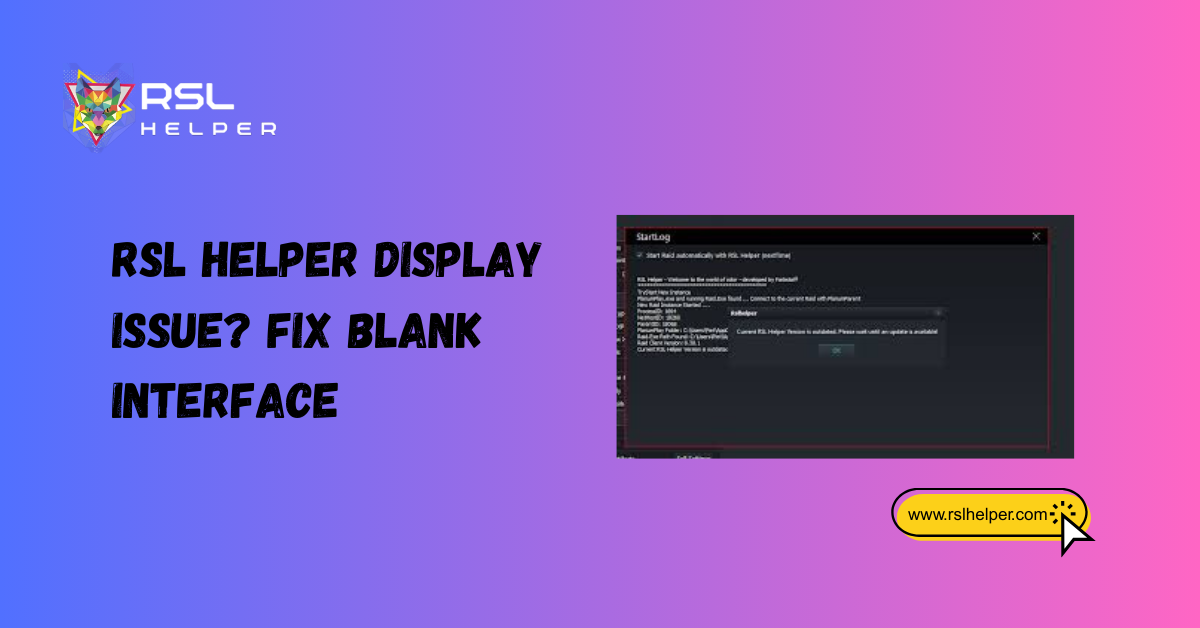
When RSL Helper Display Issue successfully initializes as a background process but fails to render its graphical window, the application has encountered a display-related failure. This state is especially annoying because the core logic is running, yet the user cannot interact with the tool. Fixing this requires a focused approach that targets the system’s display environment rather than the application’s functional code.
The nature of UI rendering problems in applications built on frameworks like .NET or Java frequently entails a mismatch between what the application expects to draw and what the Windows Graphics Device Interface (GDI) or DirectX allows it to render.
The issue is rarely a crash it is a rendering deadlock or a failure to obtain the correct memory allocation for the window elements, leading to a window frame that is either entirely transparent, black, or positioned off-screen. This is exacerbated by the wide range of modern monitor setups, resolutions, and scaling factors.
What Causes Interface Display Failure in RSL Helper
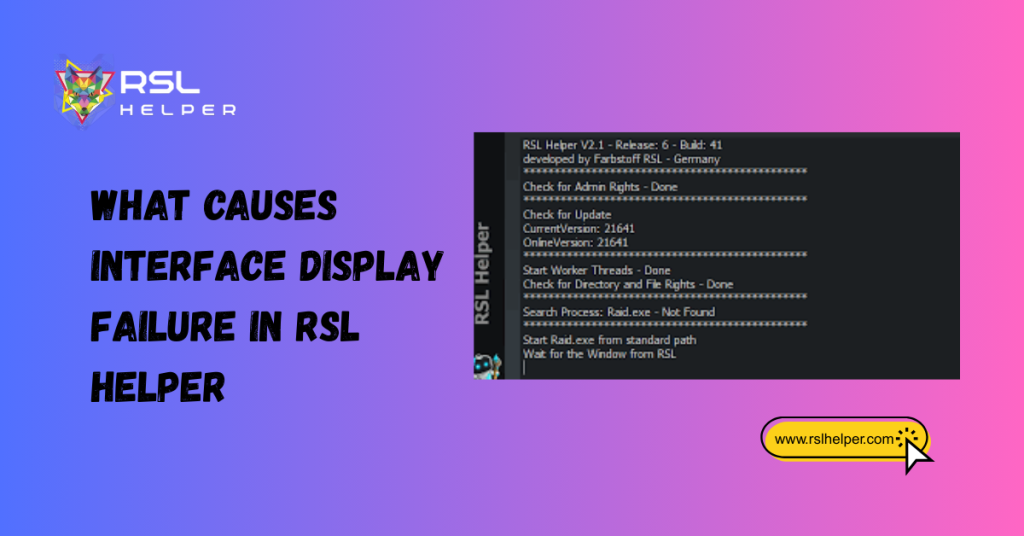
The troubleshooting process must isolate the issue to one of these three distinct areas.
Corrupt UI configuration files
This is the most common and easiest issue to resolve. A Corrupt UI configuration file occurs when the application crashes or is forced closed while writing its settings, corrupting the entries for window coordinates, themes, or panel visibility. Upon the next launch, RSL Helper reads the damaged coordinates and fails to render the window correctly.
Graphics driver conflicts
A Graphics driver conflict arises when the installed driver for the dedicated or integrated GPU is not fully compatible with the specific version of the .NET or C++ rendering components used by RSL Helper. The result is often a silent failure where the driver refuses to render the application’s window elements, leading to a blank screen or a black box.
Windows visual rendering issues
These are high-level conflicts, often stemming from overly aggressive User Account Control (UAC) settings, specific accessibility options, or multi-monitor configurations where the app is inadvertently launching on a disabled virtual desktop or an unused physical display.
Refreshing the RSL Helper Interface Display
Before making any system-level changes, the application’s interface memory must be cleared.
How to reset UI layout settings safely
This involves locating the application’s configuration file, typically an .ini or .json file located in the user’s Documents\RSLHelper or AppData\Local folders. To reset UI layout settings safely, close the application completely (verify in Task Manager), back up this configuration file, and then delete it. This forces RSL Helper to create a new file with default, centered window coordinates upon the next launch, resolving issues caused by off-screen placement.
Steps to rebuild visual assets
RSL Helper maintains a local cache of visual components, such as icons, images, and pre-rendered interface elements. If these files are partially downloaded or corrupted, they can trigger the rendering freeze. Steps to rebuild visual assets require browsing to the main RSL Helper installation folder, locating the Cache, Temp, or Assets subfolders, and manually deleting their contents. This forces the application to redownload and regenerate fresh, clean visual components.
Verifying UI load completion status
After clearing the config and cache, restart RSL Helper. If the application is successfully visible, the process is complete. If it remains blank, check the Task Manager: if the application’s CPU usage spikes, then immediately drops, and its memory consumption stabilizes, the UI has technically loaded, indicating the problem is a persistent graphics or placement conflict requiring a system-level fix.
Checking GPU and Display Compatibility
System drivers must be stable and compatible with the tool’s required rendering mode.
- Confirming graphics mode requirements
RSL Helper, like many automation tools, often uses basic graphical user interface (GUI) frameworks. Confirming graphics mode requirements means making sure your Windows system is not set to any unusual color depths or resolutions that may interfere with the specified frameworks. Basic 32-bit color depth and a standard 1080p resolution are usually required.
- Updating or rolling back display drivers
This is often the fix for blank screens caused by driver bugs. If the issue started after a driver update, rolling back the display driver via Device Manager can restore functionality. Conversely, if the driver is very old, updating to the latest stable version from AMD, NVIDIA, or Intel is important to guarantee support for modern UI libraries.
- Switching rendering methods for stability
Some applications allow the user to disable hardware-accelerated rendering in favor of a more stable, albeit slower, software rendering mode. If RSL Helper’s configuration file allows for this setting change, manually switching this flag can bypass driver bugs entirely, forcing the CPU to render the UI instead of the GPU.
Fix RSL Helper Screen Rendering Conflicts
External programs or Windows settings can actively prevent the screen from being drawn.
| Disabling overlay or enhancer software | Temporarily close or explicitly whitelist RSL Helper in all overlay programs (Discord, Steam, Afterburner, etc.). | High risk of hidden interference; overlays inject code that can conflict with the app’s rendering pipeline. |
| Fixing GPU acceleration issues | Check RSL Helper’s configuration file for an ‘EnableHardwareAcceleration’ flag. Set this to ‘False’ (or equivalent) to force software rendering. | Bypass known bugs in specific GPU drivers that cause blank white or black screens. |
| Adjusting high DPI settings for clarity | Right-click RSL Helper executable -> Properties -> Compatibility -> Check “Override high DPI scaling behavior” and set the scaling to Application. | High DPI scaling often miscalculates window size; forcing Application control resolves most common scaling issues. |
Rebuilding Application Assets and Cache
When local data validity is suspect, a more aggressive clean is necessary.
- Clearing old UI cache folders
Repeatedly deleting the cache is harmless and highly effective. Clearing old UI cache folders eliminates any possibility that a corrupted image or asset file is causing the initialization freeze.
- Restoring missing or damaged interface files
If a corrupt download caused RSL Helper to start correctly as a background process during installation, core interface files might be missing. If a repair option is available in the installer, run it. Otherwise, a full clean reinstallation is necessary.
- Ensuring proper folder access rights
Lack of write access can prevent the application from saving the window’s state after a successful launch, but lack of read access can prevent it from reading the initial state, causing a hang. Guaranteeing appropriate folder access rights (Full Control for the user account) must be verified on the main installation folder.
Advanced Fix Options for Blank Screens
These steps address deep-rooted or unusual environmental conflicts.
Running the app with compatibility layers
Use the Windows built-in compatibility troubleshooter to try. Running the app with compatibility layers set for an older, more stable version of Windows (e.g., Windows 8 or Windows 7). This forces the system to use legacy rendering modes.
Forcing window mode across displays
If the application process is running but the window is invisible, select the application in the Task Bar, press ALT + SPACE, then M (for Move), and use the arrow keys to try to drag the hidden window back into view. This is essential for forcing window mode across displays.
Repairing absent components
RSL Helper’s framework relies heavily on core Windows components. Use the Microsoft .NET Framework Repair Tool and the System File Checker (sfc /scannow) command to scan and repair potentially absent components within the Windows operating system itself.
Prevention Tips for Long-Term UI Stability
- Update schedule and driver management: Establish a regular Update schedule and driver management routine. Only install GPU drivers that have been released for a few weeks and proven stable, avoiding installing brand-new beta drivers immediately.
- How to avoid UI corruption triggers: Always use the application’s built-in exit button to close RSL Helper. Avoid closing the application via the Task Manager, as this prevents it from safely writing its configuration, which is the primary UI corruption trigger.
- Safe graphics configuration practices: When troubleshooting, keep RSL Helper’s graphics settings and Windows scaling settings as simple as possible. Avoid forcing aggressive anti-aliasing or vertical sync settings on the application via the GPU control panel.
Frequently Asked Questions
Why does RSL Helper Display Issue and showing no interface?
RSL Helper loads but shows no interface because its rendering process is blocked by Graphics driver conflicts, Corrupt UI configuration files (window position/size), or conflicts with Windows high DPI settings.
Can graphics drivers cause blank UI problems?
Yes, graphics drivers can cause blank UI problems if they are outdated or contain bugs that conflict with RSL Helper’s framework, frequently necessitating updating or rolling back display drivers.
How do I reset the RSL Helper interface layout?
To reset the RSL Helper interface layout, you must close the application and manually delete the configuration file (.ini) that stores window position and size settings.
What cache folders affect visible UI loading?
Cache folders affect UI load time by storing temporary visual assets; clearing old UI cache folders forces the program to rebuild these graphical elements upon restart.
Should I disable overlays or hardware acceleration?
Yes, you should disable overlays or graphics processing unit acceleration (if possible via config) as they are common sources of Screen Rendering Conflicts that can result in a blank window.
Why does DPI scaling break the interface?
DPI scaling breaks the interface when it miscalculates the window size, often leaving it off-screen or too large. This is fixed by adjusting the high DPI settings in the executable’s properties.
Can corrupt configuration files cause blank screens?
Yes, corrupt configuration files can cause blank screens if they contain invalid window coordinates, causing the application to fail to draw the window in a visible location.
Do I need to reinstall to fix UI rendering?
You usually do not need to reinstall to fix UI rendering. Start with refreshing the RSL Helper Interface Display (config/cache clear) and driver checks, as these resolve the vast majority of issues.
Conclusion
Resolving a blank interface requires a methodical, two-pronged attack: clearing all internal memory of the application’s screen state (UI reset) and guaranteeing the host Windows environment is free of rendering conflicts (correct graphics setup). The persistent character of these problems frequently indicates underlying driver instability or excessively aggressive scaling settings. By giving precedence to local data cleanup and then verifying system compatibility, stability is quickly restored
The solution lies in two core steps: performing a safe UI reset by clearing all window configuration files, and ensuring a correct graphics setup by resolving driver issues and high-DPI scaling conflicts. This combination eliminates all common causes of rendering failure, securing a dependable interface and ensuring that the application is both running and fully visible for interaction.
Latest Post:
- RSL Helper Stuck on Loading Screen: Fix with Cache Reset & Config Check
- RSL Helper Installation Failed—Common Causes Explained
- RSL Helper Apps Stuck During Installation—Causes and Solutions
- RSL Helper Shows Success but App Isn’t Visible – What’s Happening?
- RSL Helper Corrupted App Installations—How to Resolve