Introduction
Firmware updates are intended to improve security and hardware effectiveness, but they frequently interfere with the delicate hooking mechanisms used by RSL Helper. Because firmware controls how the hardware communicates with the Operating System, a minor update in the device’s kernel can render the current version of the Helper unable to read game data. Understanding this impact is the first step toward maintaining a high-performance, stable farming environment.
How new firmware affects app communication
New firmware often changes the API signatures that external tools need to handshake with the game client. If the firmware tightens safety procedures, RSL Helper might find its data requests blocked, leading to synchronization lags or incomplete data packets during gear-selling routines.
Why do interoperability difficulties appear
Compatibility gaps occur when the firmware’s interface protocols outpace the RSL Helper’s internal code. Developers of the Helper must reverse-engineer these new firmware paths to ensure that the memory offsets for Raid: Shadow Legends remain accessible and accurate.
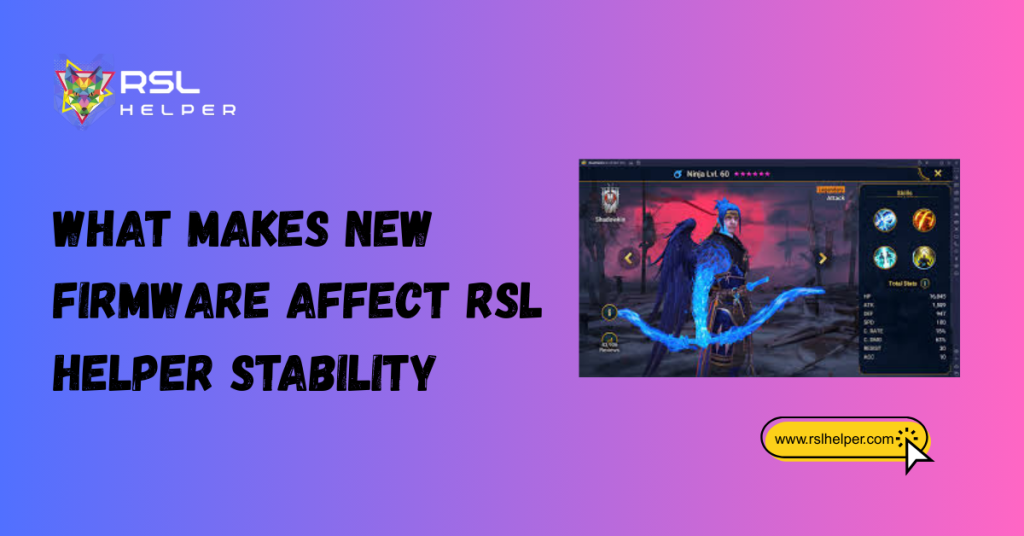
What Makes New Firmware Affect RSL Helper Stability
| Driver & Security Layer Changes | New firmware often updates the underlying RSA key signatures for USB debugging. If these signatures aren’t refreshed on the PC, the Helper will be denied access to the device’s kernel, causing immediate connection drops. |
| Updated Communication Protocols | Firmware shifts from older ADB versions to newer, more encrypted protocols. This requires the RSL Helper to update its internal binaries to match the host device’s data transfer speed and encryption. |
| System Permission Restrictions | Modern firmware frequently resets “Developer Options” or “Install via USB” toggles to their default ‘Off’ state. This silently breaks the Helper’s ability to inject scripts or read the screen buffer until manual permissions are re-granted. |
Evaluating Firmware Readiness for RSL Helper
Checking supported firmware versions
Before clicking “RSL Helper Update” on your device, compare the build number with the RSL Helper Supported Versions” list on GitHub or Discord. Semantic keywords like “Build Signature” and “API Level” are vital to ensure your hardware doesn’t move to a software version that the software hasn’t yet mastered.
Verifying driver compatibility
New firmware frequently requires updated Universal ADB Drivers on your Windows PC. If you attempt to run the latest firmware on 2-year-old drivers, data throughput will be unstable, leading to the “Device Found but Unresponsive” error.
Reviewing developer release details
Always scan the “Patch Notes” for phrases such as “Kernel Update” or “USB Stack Refactor.” These phrases indicate a significant change in how the device handles data, so wait for a corresponding RSL Helper update before proceeding with the firmware upgrade.
Safe Usage Guidelines for Updated Firmware Devices
Reducing risk during installation
Ensure all automation scripts are paused, and RSL Helper is completely closed before initiating a firmware update. This prevents the software from attempting to “hook” into a system that is currently rewriting its own core logic, which is the primary cause of firmware-related crashes.
Assuring a clean system environment
After a firmware update, clear the RSL Helper Temp and Cache folders. Fresh firmware often interacts differently with cached UI elements; clearing these ensures the app fetches new, accurate assets that correspond with the updated system display drivers.
Protecting device data and settings
Maintain a “Gold Snapshot” of your RSL Helper Config folder on an external drive. Firmware updates can occasionally trigger a device factory reset or a storage partition change, which could wipe your custom gear filters if they aren’t backed up.
Optimising RSL Helper Setup on Latest Firmware
Adjusting key application settings
On the latest firmware, you may need to toggle “Hardware Acceleration” or “Legacy Hooking” within the RSL Helper settings. New firmware often optimises GPU usage, and the Helper must be informed how best to utilise these new rendering paths to avoid UI flicker.
Boosting device connection reliability
Switch to a High-Speed USB 3.0 port (usually blue) on the rear of your motherboard. Modern firmware utilises higher-bandwidth data verification, and older USB 2.0 ports may provide insufficient current, causing the connection to time out during heavy asset loads.
Improving performance response time
Set the RSL Helper process priority to “Above Normal” in the Windows Task Manager. This ensures the CPU prioritises the Helper’s requests for the new firmware, reducing the latency between a “Game Event” and the “Helper Response.”
Fixing Compatibility Conflicts After Firmware Upgrade
- Addressing connection failures: Re-toggle USB Debugging on the device. Firmware updates commonly keep the toggle ‘On’ visually but disable the background service; flipping it off and then back on forces the firmware to restart the listener service.
- Resolving recognition errors: Uninstall the device from the Windows Device Manager, and reconnect it. This forces Windows to pair the new firmware signature with the correct driver, fixing the “Unknown Device” loop.
- Handling black screens or app hangs: If the Helper shows a black screen after an update, it is likely due to a mismatch in Screen Resolution metadata. Reset your device’s resolution to “Standard” to allow the Helper’s overlay to re-map the UI correctly.
When to Avoid Using RSL Helper on New Firmware
Identifying high-risk builds
Avoid using the Helper on “Beta” or “Developer Preview” firmware. These builds are notorious for unstable USB stacks and for frequently changing their security permissions, which can cause RSL Helper to crash mid-battle and waste your Energy.
Detecting system conflicts
If your PC’s Event Viewer shows repeated “Kernel-PnP” errors after connecting your updated device, there is a firmly established driver conflict. In this scenario, using the Helper is unsafe as it could trigger a Blue Screen of Death (BSOD) or data corruption on your SSD.
Preventing long-term damage
Excessive “Retries” by the Helper to connect to an incompatible firmware version can cause thermal stress on the device’s CPU. If the connection fails more than three times, stop the app and wait for a software patch to ensure hardware longevity.
Long-Term Safety Strategy for Firmware Updates
Timing update cycles correctly
Never update firmware during a Fusion Event or a “CVC” (Clan vs Clan) tournament. The optimal time to update is during “Down Weeks, when a potential 24-hour troubleshooting window won’t impact your competitive standing in the game.
Creating backup restore points
Before a major firmware shift, create a System Restore Point on your PC and a complete backup of your device. This allows you to “Time Travel” back to a functional state if the new firmware and RSL Helper prove to be fundamentally incompatible.
Monitoring future compatibility notes
Subscribe to official developer channels and use semantic search queries like “RSL Helper [Firmware Version] issues.” Keeping up to date with the community’s experience helps you avoid problematic builds with known stability regressions.
Frequently Asked Questions
Does the new firmware break compatibility with RSL Helper?
New firmware often changes RSA security keys and USB protocols, temporarily blocking RSL Helper’s data injection. A software patch or driver refresh is usually required to restore the communication bridge.
How do I safely use RSL Helper on updated devices?
Ensure USB Debugging is re-enabled and run RSL Helper as an Administrator. This gives the software the required permissions to bypass the stricter security layers found in modern firmware builds.
What fixes firmware-related app crashes?
Crashes are typically fixed by clearing the AppData Cache and updating your PC’s Visual C++ Redistributables. These actions ensure the Helper uses modern libraries that correspond with the updated firmware logic.
Should I delay firmware updates for RSL Helper?
Yes, delay updates during Major Gameplay Events like Fusions. This avoids unforeseen downtime and allows you to wait for community confirmation that the new firmware is stable for long-term automation.
Why does device detection fail after a firmware upgrade?
Detection fails because firmware commonly updates Reset Authorized PC Keys. You must re-check your device screen for the “Allow USB Debugging” prompt and authorise it to re-establish the encrypted handshake.
Can firmware cause RSL Helper instability?
Absolutely. If the firmware’s Power Management is too aggressive, it will kill the Helper’s background tasks. Disabling battery optimisation for the app usually resolves this issue and prevents mid-farm crashes.
How to confirm firmware support status?
Check the GitHub “Issues” tab or the official Discord announcements for your specific build number. If developers or users report “Stable” performance on that version, it is safe to proceed with the upgrade.
Is a rollback required for stable performance?
A rollback is a Last Resort. Most firmware issues are resolved by updating PC drivers or adjusting Helper settings. Only roll back if the firmware has a documented bug that prevents stable USB communication.
Conclusion
Overcoming the difficulties of firmware updates is a hallmark of an advanced RSL Helper user. While these updates deliver necessary security patches, they require an anticipatory maintenance approach. By prioritising Driver Synchronisation, Permission Audits, and Planned Timing, you can bridge the gap between new hardware logic and stable software performance.
Strategies for Long-Term Version Stability
The key to long-term success is “Data Redundancy” and “Version Awareness.” Never assume an update is “Plug-and-Play”; instead, treat every firmware change as a new environment that needs to be optimised. With proper planning, backing up your sell filters and monitoring developer notes, you can ensure that your RSL Helper stays a dependable, high-speed asset regardless of how often your device’s firmware evolves. Achieve total control over your Telerian journey by keeping your system’s foundation as stable as your winning strategies.
Latest Post:
- RSL Helper Stuck on Loading Screen: Fix with Cache Reset & Config Check
- RSL Helper Installation Failed—Common Causes Explained
- RSL Helper Apps Stuck During Installation—Causes and Solutions
- RSL Helper Shows Success but App Isn’t Visible – What’s Happening?
- RSL Helper Corrupted App Installations—How to Resolve